For most nitro coffee applications, 4.1g N2 cartridges are the more reliable choice because they provide better pressure stability, stronger cascade performance, and more consistent results across repeated pours.
2g cartridges can still work, but they are typically better suited for compact systems or small-volume use where portability matters more than presentation.
Nitro coffee is not just about injecting nitrogen — it is about how stable the system feels during use. Foam texture, cascade effect, and consistency between servings are all influenced by how much gas is available and how long pressure can be maintained.
Quick Decision Snapshot
- 4.1g → better for stable nitro effect and repeated serving
- 2g → better for compact or single-use setups
- Cartridge size directly affects pressure hold and foam quality
- Undersized cartridges often lead to weaker and less consistent pours
Why Cartridge Size Matters in Nitro Coffee
Nitrogen behaves differently from CO2 when used in beverages. It has much lower solubility, which is why nitro coffee creates a smooth texture and cascading visual effect instead of sharp carbonation.
That also means nitro systems depend more on pressure consistency than gas type alone. If the gas volume is too low, the system may still function, but the result often feels underpowered — weaker cascade, thinner foam, and less repeatability.
This relationship between nitrogen behavior, pressure, and liquid interaction is also discussed in technical resources such as nitrogen infusion in beverages from the Specialty Coffee Association.
Core Comparison: 2g vs 4.1g
| Factor | 2g N2 Cartridge | 4.1g N2 Cartridge |
|---|---|---|
| Gas volume | Lower | Higher |
| Pressure support | Limited | More stable |
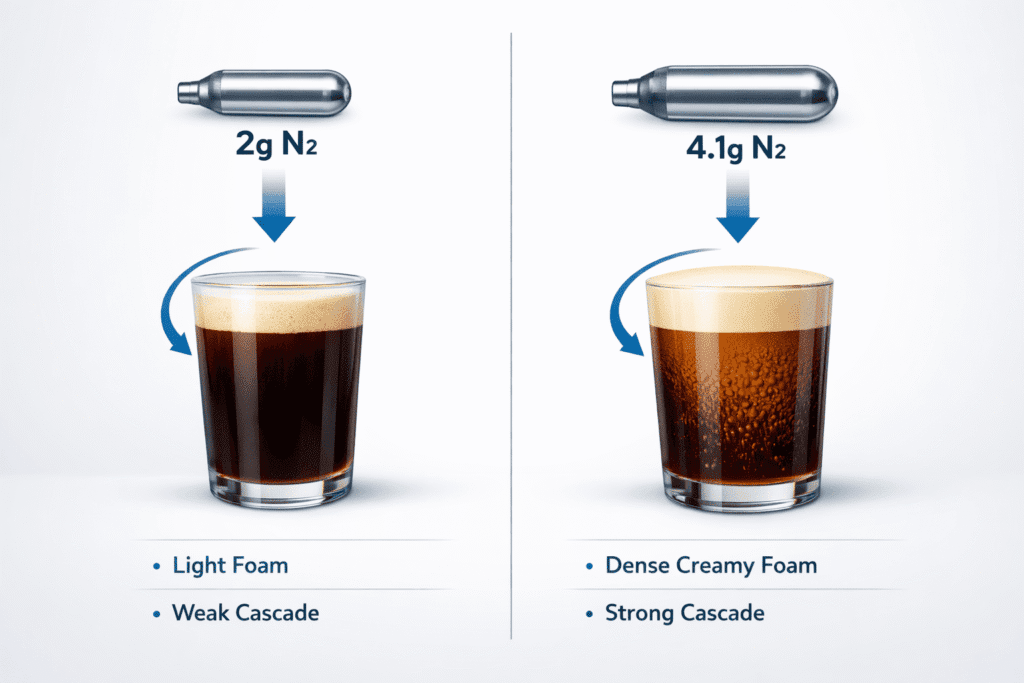
| Foam texture | Light | Dense & creamy |
| Cascade effect | Short-lived | Strong & lasting |
| Best-fit systems | Compact / small-volume | Standard nitro setups |
| Consistency | Variable | Reliable |
What Actually Changes in Real Use
In practice, the difference between 2g and 4.1g cartridges shows up in how the coffee looks and behaves in the glass.
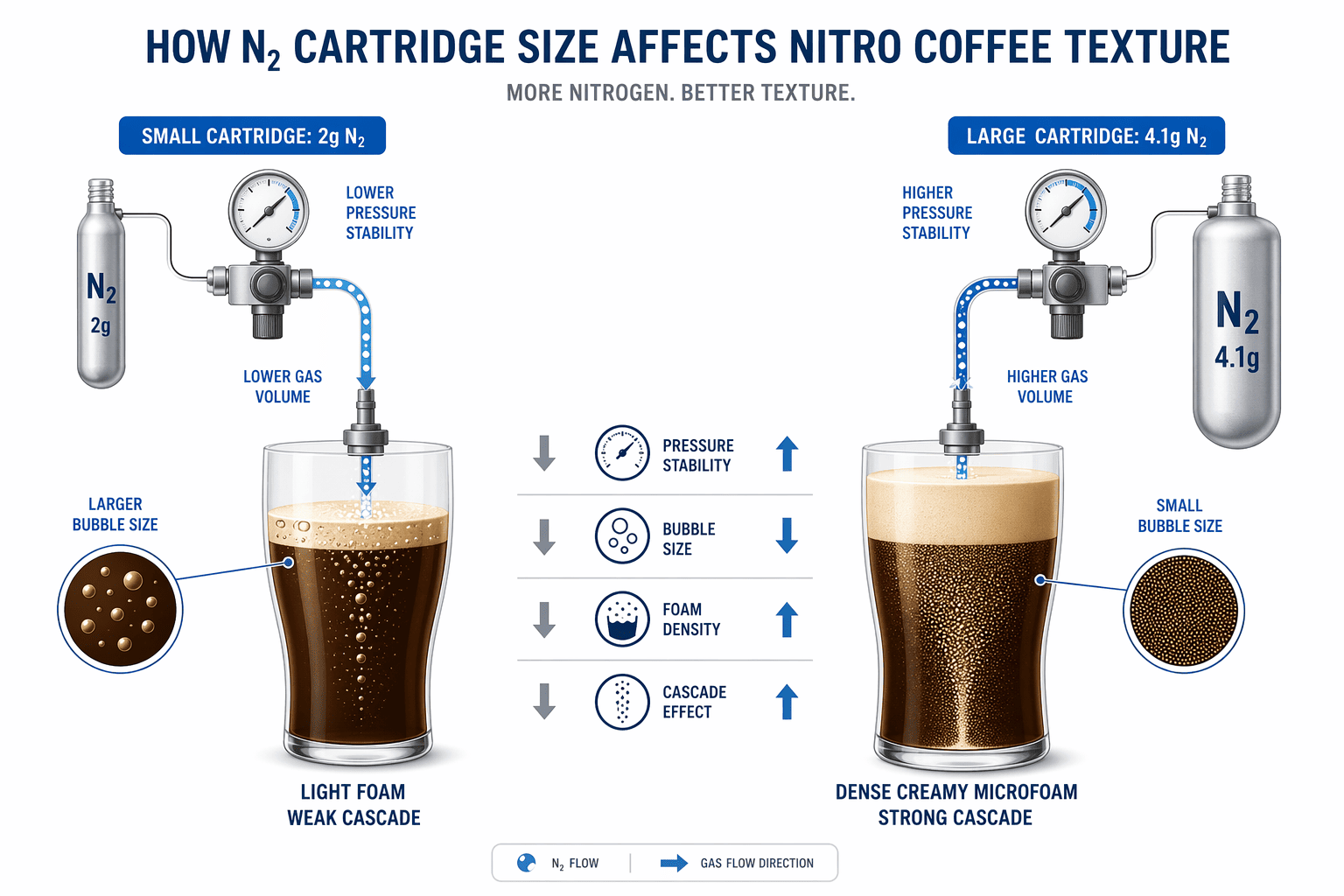
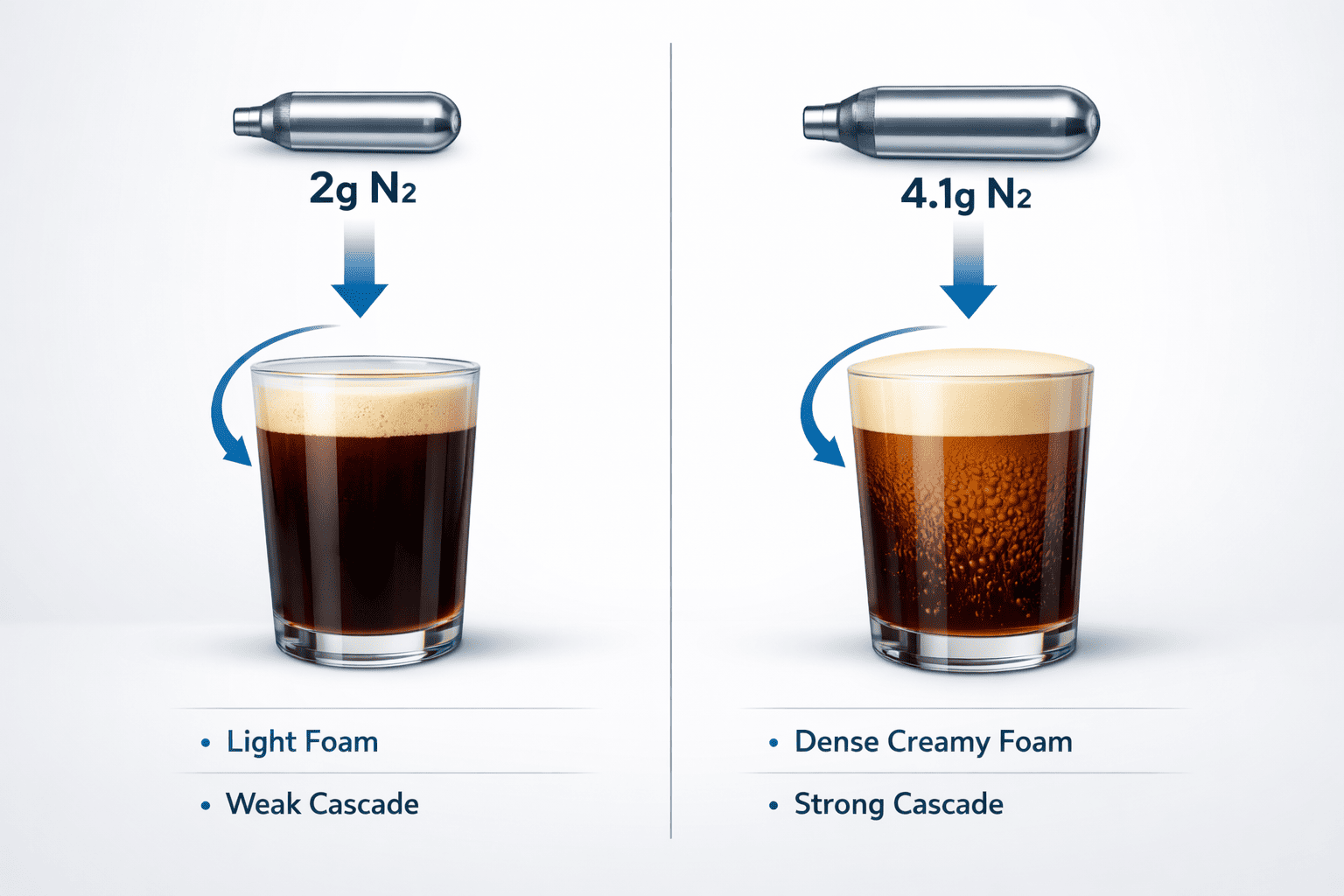
- Smaller cartridges tend to produce lighter foam and shorter cascade duration
- Larger cartridges maintain pressure longer, resulting in fuller texture and more stable visual effect
👉 How does N2 cartridge size affect nitro coffee texture?
System Matching Is More Important Than Size Alone
Choosing the right cartridge is less about “which is better” and more about whether it matches the system.
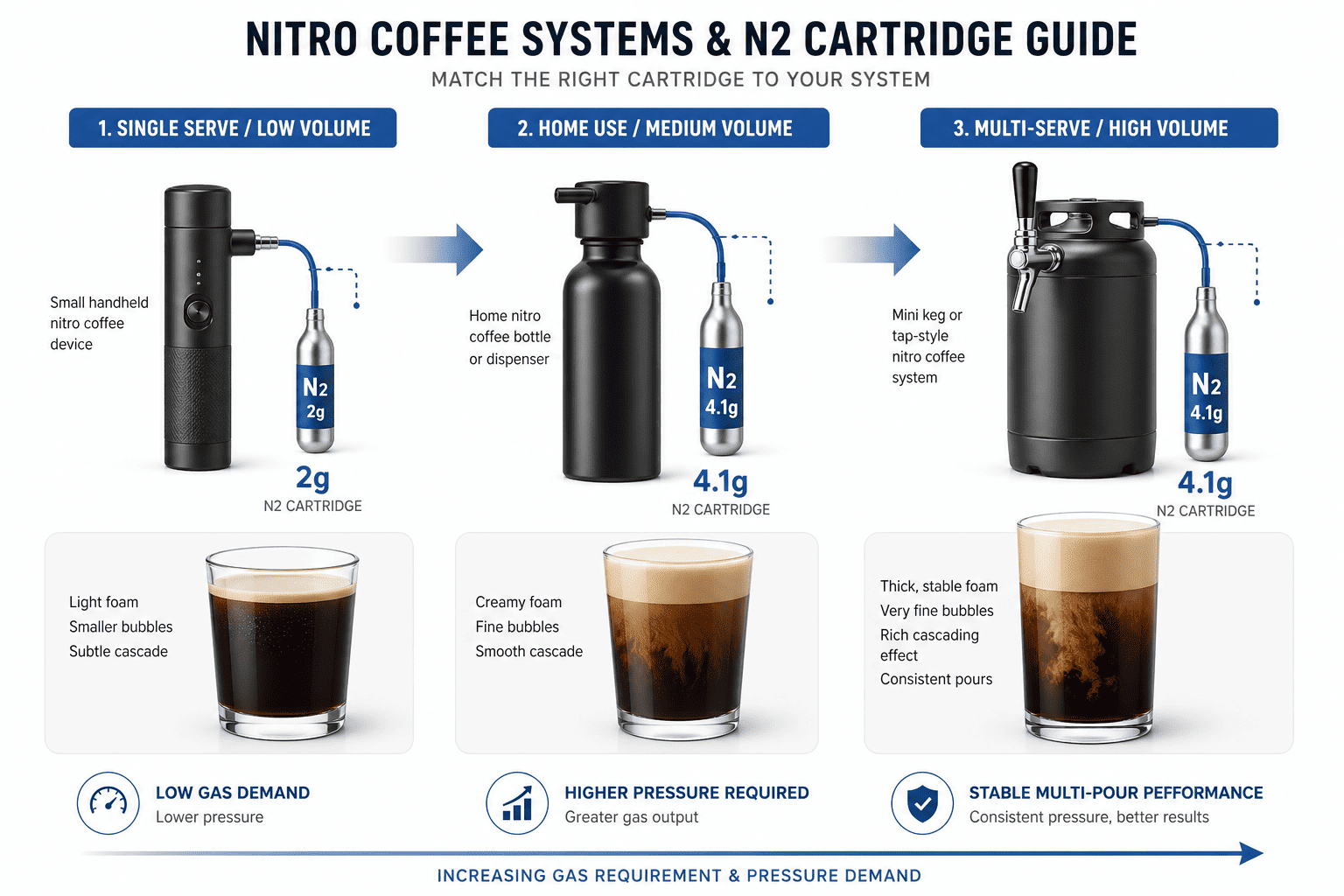
- For very small or handheld brewers, 2g may be enough
- For countertop systems or repeated serving scenarios, 4.1g usually provides more stable performance
👉 Which nitro coffee systems require 4.1g N2 cartridges?
Cost vs Performance: What Buyers Often Miss
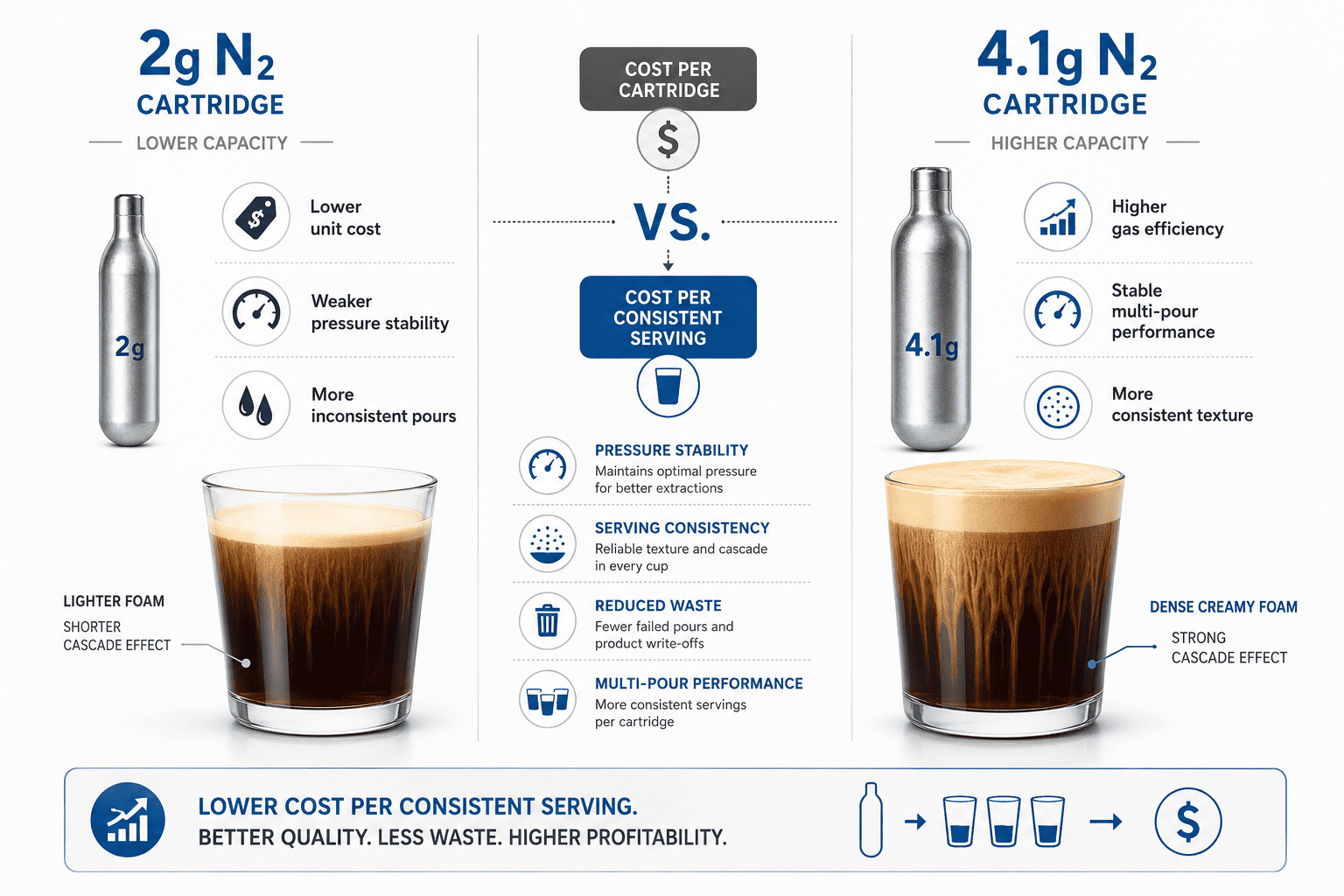
It’s common to assume that smaller cartridges are more economical. However, if a cartridge does not provide enough pressure:
- pours may become inconsistent
- foam quality may drop
- multiple attempts may be needed
In those cases, the actual cost per serving can increase rather than decrease.
👉 Is 4.1g more cost-effective than 2g N2 cartridges?
How This Affects Product Selection
When buyers evaluate N2 cartridge sizes, they are usually also considering system compatibility, serving volume, and product positioning.
A broader overview of how different cartridge formats match coffee applications can be found in N2 cartridges for coffee applications, especially when comparing packaging formats and use scenarios.
Final Takeaway
For most real-world nitro coffee setups, the difference between 2g and 4.1g cartridges is not about compatibility — it is about performance margin.
A 2g cartridge may work in smaller systems, but it often leaves very little room for stable pressure and consistent results.
A 4.1g cartridge provides a more reliable balance between gas volume, pressure stability, and visual presentation.
In practical terms:
- If your system is compact or used occasionally, 2g can be sufficient
- If your system requires repeatable results and consistent presentation, 4.1g is usually the safer choice
If the setup goes beyond single-serve use or needs to deliver the same result across multiple pours, choosing 4.1g is generally the more practical decision.