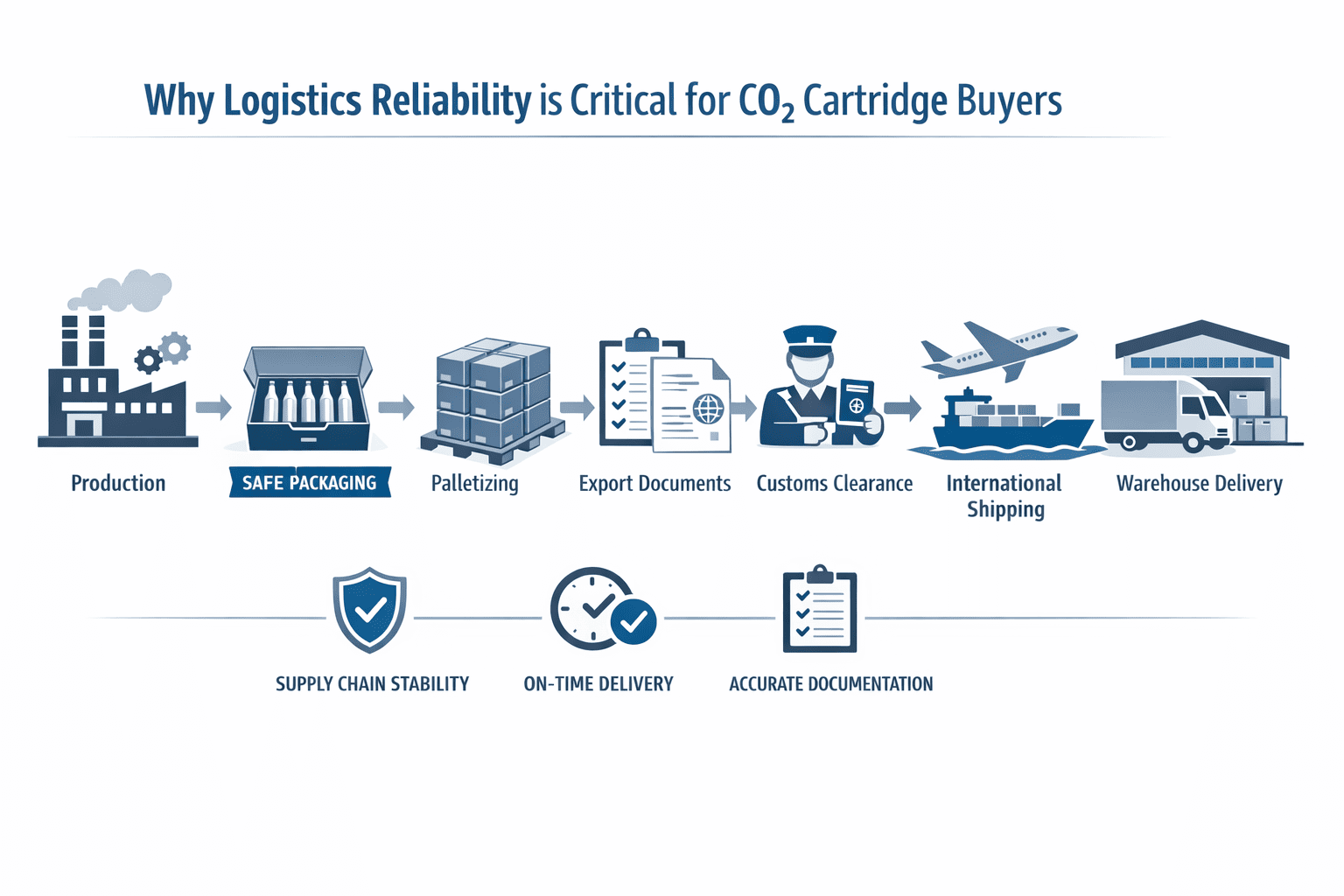
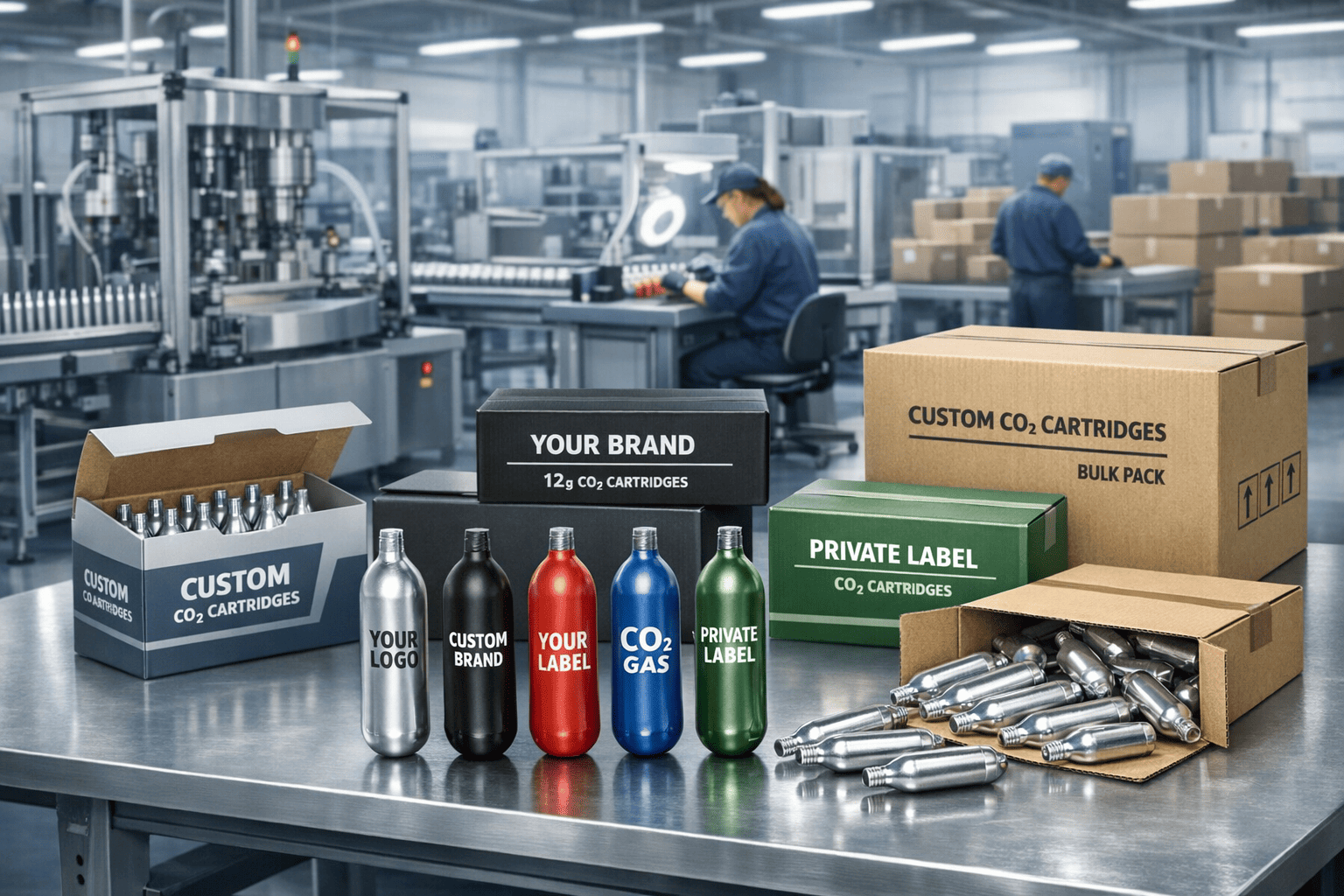
Small CO2 cartridge orders look simple on paper.
In reality, they are the ones most likely to get stuck at customs.
I have seen small trial orders delayed for weeks, while full containers passed in days. Buyers often assume this is bad luck. It is not. Almost every delay follows a clear pattern. Once you understand that pattern, customs stops being a black box.
Small CO2 cartridge orders get held at customs because of unclear product declarations, missing safety documents, and mismatched use claims. The fix is aligning gas grade, cylinder specs, paperwork, and shipping method before the goods ever leave the factory.
If you are a distributor, wholesaler, or brand testing the market with a small order, this article is for you. I am writing this as a factory owner who ships CO2 cartridges every month, not as a marketer.
Why Small CO2 Cartridge Orders Are Flagged More Often
In our daily shipments, small orders are inspected more often than large ones. That is a fact.
Customs systems are built to manage risk. A small order usually means a new buyer, a new importer record, or a trial shipment. All three raise flags automatically. When the product is a pressurized gas cylinder, the inspection rate increases again.
CO2 cartridges are not treated as normal metal parts. Even though the product is small, customs sees three risk layers at the same time: pressure, gas content, and end use. If any of these are unclear, the shipment stops.
Many buyers make the situation worse without realizing it. They describe the product too loosely. They mix use cases in one order. Or they copy a generic HS code from another product page. Customs officers do not guess. If the documents do not clearly match a known category, they will hold the goods.
From our experience, small orders fail not because of size, but because of preparation.
The Most Common Paperwork Mistakes We See
Almost every customs delay starts with documents, not the product itself.
The first problem is the commercial invoice. Many small buyers ask us to “keep it simple.” They want short descriptions like “CO2 accessory” or “metal cylinder.” This creates confusion. Customs needs clarity, not simplicity.
The second issue is HS code mismatch. CO2 cartridges sit between categories. They are metal containers, but they are also gas carriers. Using the wrong HS code can change inspection rules and duty logic. Once customs sees a mismatch, the shipment moves to manual review.
The third missing piece is MSDS. Some buyers think MSDS is only for chemicals. CO2 is not toxic or flammable, but it is still a compressed gas. Without MSDS, customs cannot assess transport and storage risk.
Here is what we insist on before shipping any small order:
| Document | Why It Matters |
|---|---|
| Commercial Invoice | Defines product identity |
| Packing List | Confirms quantities |
| Correct HS Code | Determines inspection rules |
| MSDS | Confirms gas safety |
| Certificate (if needed) | Market compliance |
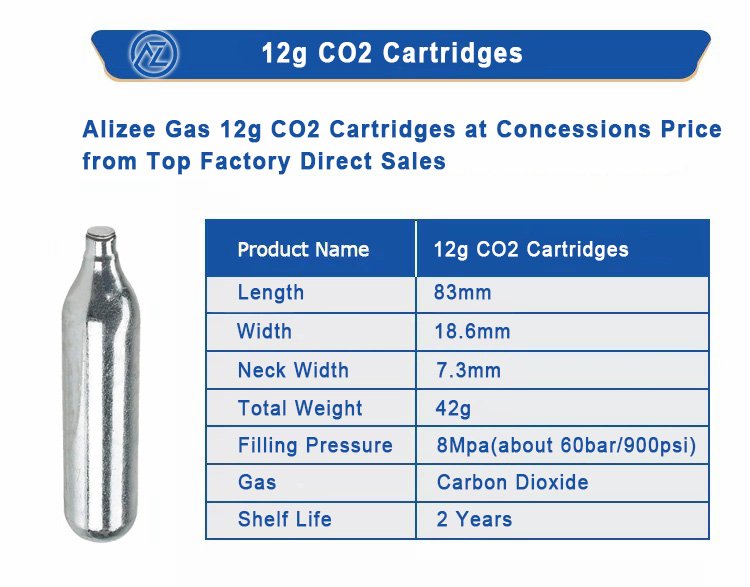
When Gas Grade Becomes a Customs Issue
Gas grade is one of the most misunderstood issues, especially for beverage-related orders.
Gas grade problems usually do not appear at customs first. They appear after the product reaches the market. We once handled a small soda cartridge order where the buyer tried to save cost by using industrial-grade CO2. The cylinders passed pressure testing, and the shipment cleared customs without issues.
Within days, consumers reported strange smells and unstable carbonation. Nothing was “wrong” on paper, but the gas quality was not designed for beverage contact.
Now, for any soda or beverage application, we only recommend cartridges that meet food-grade standards in gas purity, cylinder cleaning, and filling environment. We also explain to buyers that soda compatibility is not only about size or thread. Gas source, internal cleanliness, and post-filling handling all matter.
More details about soda-compatible cartridges are explained on the Alizeemetal CO2 for soda maker page, where we clearly separate beverage use from industrial or inflation use.
What Makes CO2 “Food-Grade” Anyway?
Food-grade CO2 is not a marketing term. It is a production standard.
To qualify as food-grade, CO2 must meet strict purification and bottling standards. This includes multi-step filtration, high-pressure leak testing, and cylinder cleanliness standards that align with food production norms.
In our factory, soda-use cartridges go through steam cleaning and residue-free drying before filling. This process is separated from industrial-grade production. We do this because once gas touches a beverage, there is no room for ambiguity.
The difference between food-grade and industrial CO2 is not always visible, but it is measurable. Purity levels, allowable contaminants, and handling environments all change. A clear technical breakdown of how these differences affect beverage use is available in the detailed comparison by WestAir Gases.
Why Beverage-Use CO2 Gets Extra Attention at Customs
When customs sees “beverage use” on documents, inspection logic changes.
CO2 cartridges for tools or inflation are treated mainly as pressure vessels. CO2 cartridges for soda or beer are treated as pressure vessels entering the food chain. That adds another layer of control.
International transport rules classify compressed gases based on physical risk, but food safety rules classify them based on end use. This is why labeling, traceability, and safety data must be consistent.
If one document says “industrial CO2” and another says “soda use,” customs will stop the shipment. They are not being difficult. They are resolving a contradiction.
Packaging and Shipping: Where Small Orders Go Wrong
Shipping method matters more for small orders than large ones.
Air freight has stricter rules for CO2 cartridges than sea freight. Quantity limits, declaration formats, and airline acceptance all vary. If the forwarder lacks experience with gas products, mistakes happen fast.
Packaging is another trigger. Loose cartridges, weak cartons, or missing inner protection raise safety concerns during inspection. Customs officers are trained to look for physical risk signs. If packaging looks unsafe, they will stop the shipment.
We have seen perfectly compliant products delayed because of poor packaging presentation. Customs requested additional inspection, which delayed release by days.
How We Prepare Small Orders to Avoid Delays
We treat small orders more carefully than large ones.
Before shipping, we confirm three things internally. First, the declared use matches the gas grade. Second, the cylinder cleaning and filling process matches the declared use. Third, all documents describe the product the same way, without shortcuts.
We also push back when buyers ask us to simplify declarations. In our experience, clarity moves faster than clever wording.
The Long-Term Fix for Small Buyers
Customs problems are not solved at the border. They are solved at the factory level.
Small buyers should work with manufacturers who understand export rules, not just production. A factory’s job is not finished when the goods leave the line. It includes documentation logic, compliance awareness, and shipping advice.
When buyers understand this early, small orders stop being risky. They become predictable.
Conclusion
Small CO2 cartridge orders get held at customs because of mismatched declarations, unclear gas grade, and poor preparation. When production, paperwork, and use claims align, even small shipments clear smoothly and without surprises.