Yes. Industrial CO2 is chemically the same molecule as food-grade CO2, but it is practically different in how it is produced, cleaned, handled, and controlled. Those practical differences are exactly what matter in beer and soda systems.
This confusion comes up all the time.
People hear “CO2 is CO2” and assume the discussion is over.
It is not.
Why the “same molecule” argument misses the point
On a chemistry textbook level, CO2 is CO2.
One carbon atom. Two oxygen atoms. No debate there.
But cafés and beverage systems do not operate inside textbooks. They operate inside real supply chains, real filling plants, real transport conditions, and real equipment that is used every day.
The question is not what CO2 is.
The question is how that CO2 was handled before it reached your system.
That is where the difference starts to matter.
Where industrial and food-grade CO2 actually diverge
The practical difference is not about chemistry.
It is about controls.
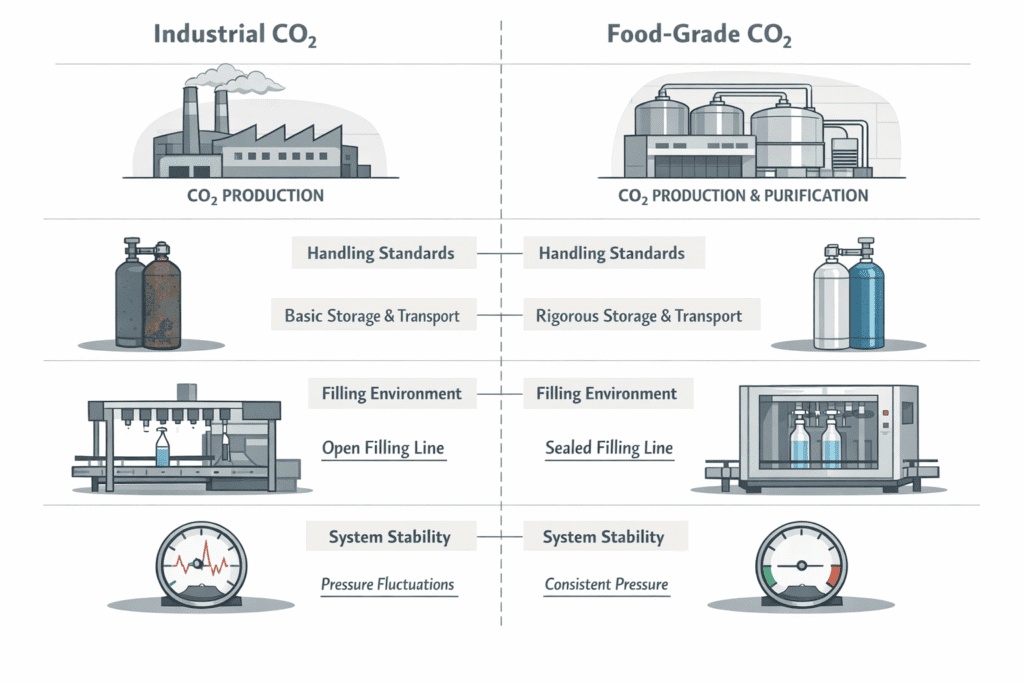
Production and purification standards
Food-grade CO2 is produced and purified under standards intended for human consumption. That means tighter limits on trace substances, oils, and byproducts from compression and storage.
Industrial CO2 is produced for manufacturing, welding, or mechanical use. It does not need to meet ingestion-related thresholds, because it is never supposed to enter food or drink.
Both gases can be “high purity” on paper.
That does not mean they are controlled the same way.
Handling, storage, and filling environments
This part is often ignored.
Food-grade CO2 is handled in filling environments designed to avoid contamination from lubricants, residues, or cross-use equipment. Cylinders and cartridges are cleaned with beverage use in mind.
Industrial CO2 may be filled on shared lines, stored near other industrial gases, or handled with equipment that is perfectly acceptable for factories—but not ideal for drinks.
None of this causes instant failure.
That is why the myth survives.
Why problems show up later, not immediately
One of the reasons people underestimate this difference is timing.
Industrial CO2 usually does not cause a dramatic, immediate issue.
Beer still pours. Soda still bubbles.
What happens instead is slower:
- Carbonation becomes harder to keep consistent
- Foam behavior changes from day to day
- Lines require cleaning more often
- Taste complaints start without a clear cause
When this happens, the gas is rarely questioned first. Regulators, taps, or recipes get blamed instead.
By the time gas quality comes up, the system has already been unstable for a while.
Why beverage systems are less forgiving than people think
Beer and soda systems rely on balance.
Pressure, temperature, and time all interact.
When gas quality is inconsistent—even slightly—it affects how CO2 dissolves and stays dissolved. That is not theory. That is basic gas–liquid behavior.
If you want a technical explanation of why small changes in gas conditions create noticeable differences in beverages, the fundamentals are clearly explained in Anton Paar’s overview of carbon dioxide behavior in beverages, which is widely used as a reference in beverage testing and carbonation control.
This is why “close enough” gas is rarely close enough in practice.
The operational difference, not the chemical one
From an operational point of view, this is the key distinction:
- Industrial CO2 is optimized for machines
- Food-grade CO2 is optimized for drinks
That difference affects:
- How stable carbonation feels during service
- How often staff need to adjust pressure
- How predictable the system is over time
Once CO2 becomes part of the beverage, the system stops behaving like an industrial tool and starts behaving like a food process.
That shift is what most people underestimate.
How this connects back to equipment and gas choice
This is why the question of direct contact matters so much.
If CO2 never meets the drink, industrial gas may be acceptable in some contexts.
If CO2 can touch or dissolve into the beverage, practical differences suddenly matter a lot more than chemical formulas.
That is the same reasoning behind why cafés serving beer and soda are usually advised to treat their systems as beverage-facing, not industrial—something I explained in detail in the main article on what gas cafés should use for beer and soda equipment that touches drinks.
Conclusion
Industrial CO2 and food-grade CO2 are chemically the same.
Practically, they are not.
The difference lies in standards, handling, and long-term system behavior—not in the molecule itself. For beverage systems, those practical differences show up slowly but consistently. Once you have seen it happen a few times, the distinction stops feeling theoretical.