Skip to content
In my experience, heavier CO2 cartridges are often perceived as “more powerful” or “more premium.” Buyers sometimes assume that more grams automatically mean better value.
In reality, that assumption is rarely examined carefully.
Heavier cartridges increase total gas capacity. But value is not determined by capacity alone. It depends on how much of that capacity is actually used.
Capacity Is Not the Same as Efficiency
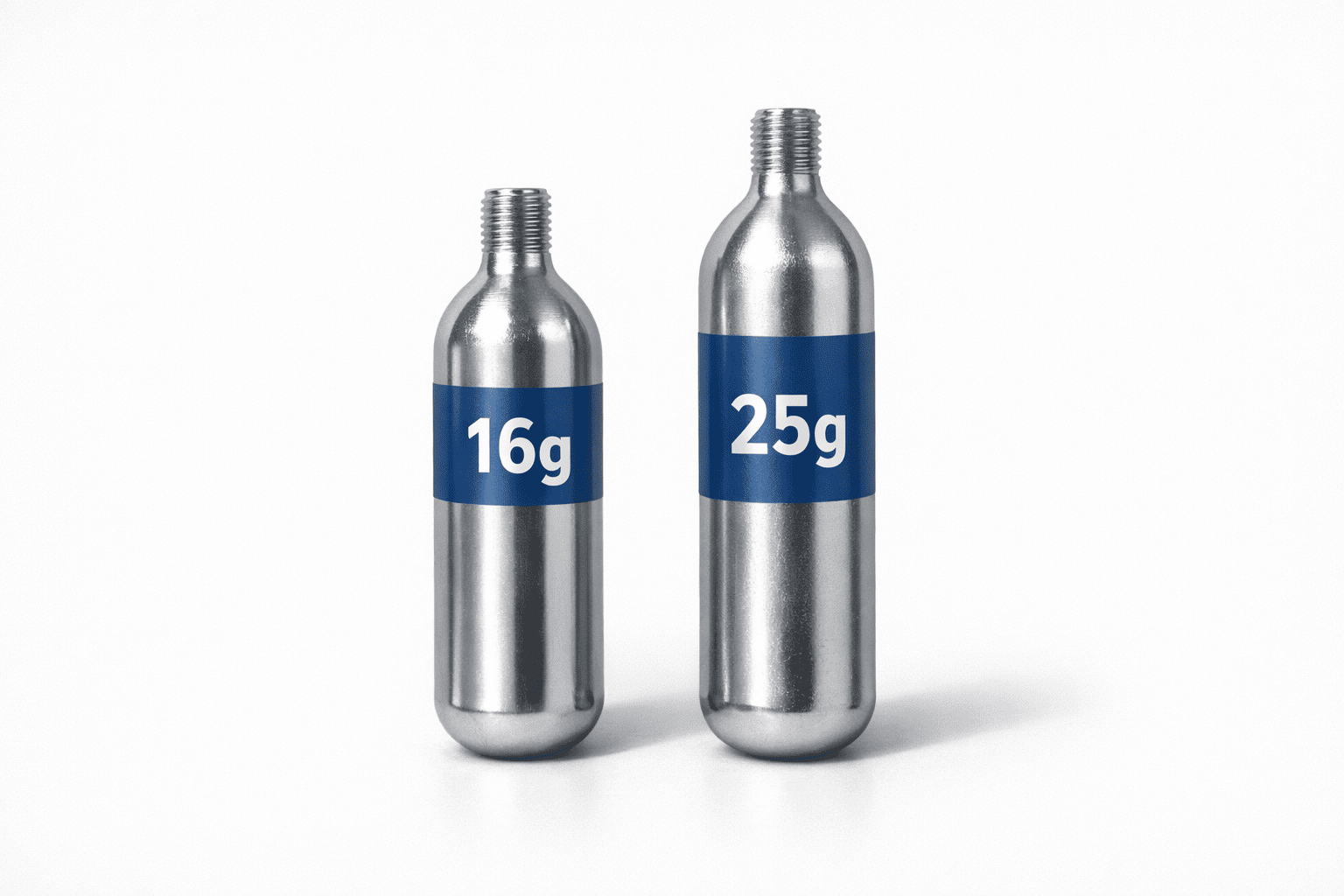
I once worked with a distributor who upgraded from 16g to 25g cartridges across an entire product line. The idea was simple: offer “stronger performance” and justify a higher price point.
After six months, the data told a different story.
Most end users were inflating standard road bike tires. The additional gas capacity was never fully discharged. Customers did not report better performance. What changed was:
- Higher per-unit cost
- Increased shipping weight
- Slightly reduced carton density
- Slower inventory turnover
The cartridge was heavier, but the usable value per application did not increase.
Value only exists when capacity matches demand.
Where Heavier Weight Makes Sense
There are situations where heavier cartridges are justified.
For example:
- Fat bike tires with larger air volume
- Cold-climate markets where pressure efficiency drops
- Safety applications requiring full discharge certainty
- Commercial use where buffer capacity reduces replacement frequency
In those cases, additional grams serve a measurable purpose.
But outside those scenarios, weight can simply become excess.
Pressure and Perception
Another misunderstanding comes from confusing weight with pressure.
CO2 cartridges operate based on vapor pressure equilibrium. The internal pressure depends primarily on temperature, not on the total gram weight inside the cartridge.
A 16g and a 25g cartridge stored at the same temperature will deliver similar pressure output during initial discharge. The difference lies in how long that discharge can continue, not how “strong” it starts.
If someone wants a clear scientific explanation of how temperature influences gas pressure, the thermodynamic relationship is well explained in the overview of vapor pressure and gas laws provided by the National Institute of Standards and Technology (NIST), which describes how gas behavior is governed by temperature rather than container size.
Understanding this principle prevents buyers from using heavier weight as a substitute for technical evaluation.
From a Manufacturing Perspective
From the factory side, heavier cartridges affect more than gas volume.
They influence:
- Steel consumption
- Total product weight
- Packaging configuration
- Freight cost per container
- Pallet stacking efficiency
A few extra millimeters in length may reduce carton quantity. A few extra grams per unit increase total shipment weight across thousands of pieces.
In container-level export, structural efficiency often matters more than perceived strength.
Measuring Real Value
When evaluating whether heavier means better, I focus on three practical questions:
- What is the real gas consumption per application?
- Does the extra capacity reduce replacement frequency in a measurable way?
- Does the increased weight improve user experience, or only increase cost?
The broader discussion about aligning cartridge specifications with actual demand instead of market habit is part of a larger framework of capacity alignment based on real usage data.
Heavier weight can be valuable. But only when it solves a real operational need.
Long-Term View
In manufacturing and wholesale distribution, perceived strength does not equal efficiency.
The clients who perform best over time are not the ones offering the heaviest cartridge. They are the ones offering the most appropriate cartridge for their specific market.
Heavier weight automatically means higher material input.
Better value depends on how efficiently that input is used.
In export-scale business, that difference becomes visible very quickly.