Private label buyers usually expect customization options that help them match product appearance, packaging, technical specifications, and brand identity to their target market. From my experience as a CO2 cartridge manufacturer, serious buyers do not only ask for a logo on the cartridge. They want a supplier that can support a full private label program in a stable and repeatable way.
Customization Priorities
- Most buyers expect logo, color, and packaging customization.
- Many buyers also want custom specifications that match their device or market.
- Good customization must stay consistent across repeat orders.
- Packaging matters because it affects retail display and distributor handling.
- Serious buyers often look for a supplier that can expand customization as their business grows.
Introduction
When buyers ask about customization, many people think they only mean printing a logo. In real B2B business, it is much more than that.
In our factory, I often see buyers begin with a simple question like, “Can you put our brand on the cartridge?” After a few more emails, the real expectation becomes much clearer. They want the product to look like their brand, fit their market, and stay the same from one order to the next. For them, customization is not only about appearance. It is part of product positioning, channel strategy, and customer trust.
This is especially true for CO2 cartridges. Some buyers sell through retail stores. Some supply dealers. Some build a branded product line for bike accessories, beverages, outdoor use, or safety equipment. In every case, they want the finished product to feel like part of their own business, not just a generic cartridge from a catalog.
That is why private label buyers usually expect more than one type of customization.
Buyers Usually Start with Logo and Visual Branding
In most cases, the first customization request is visual branding.
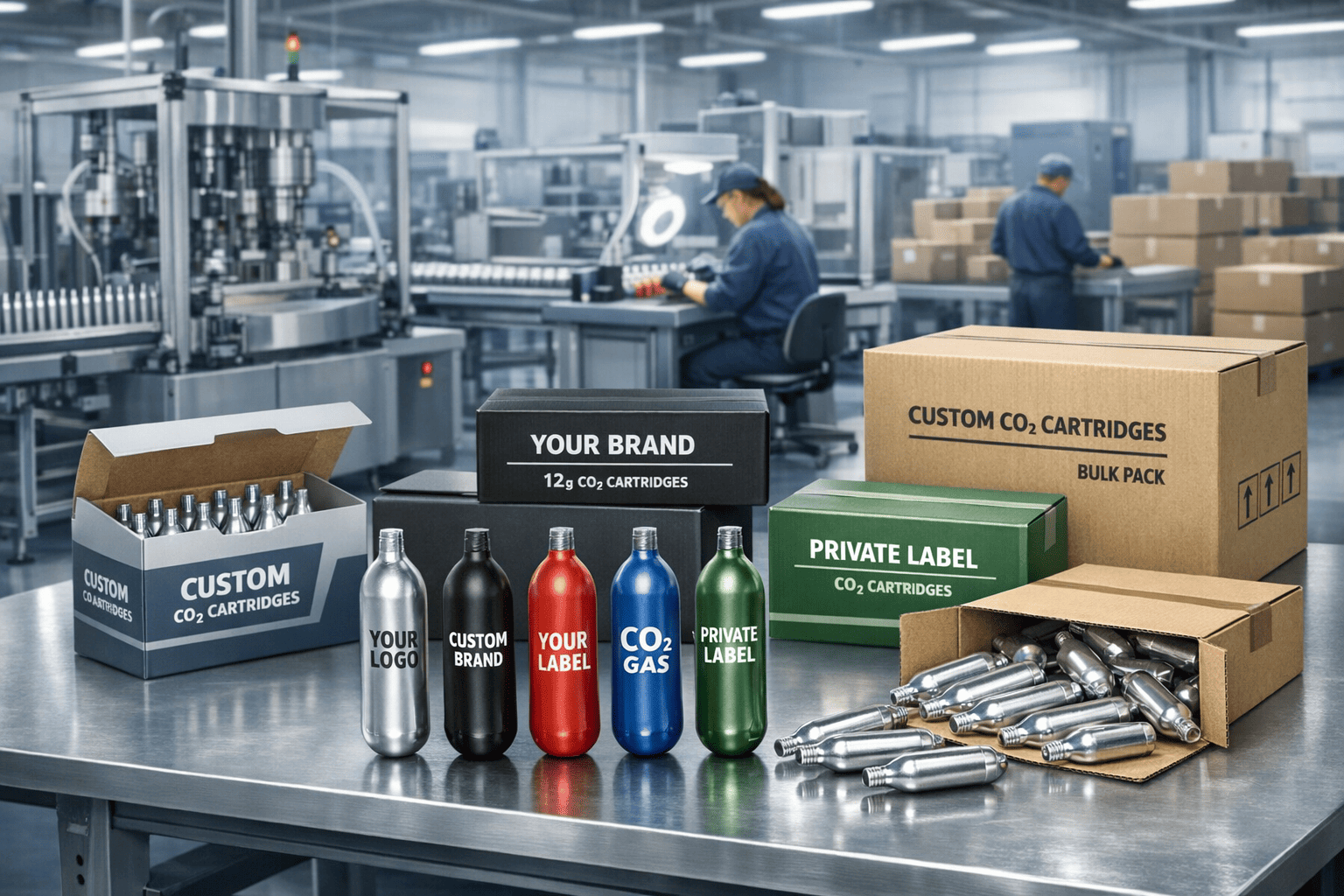
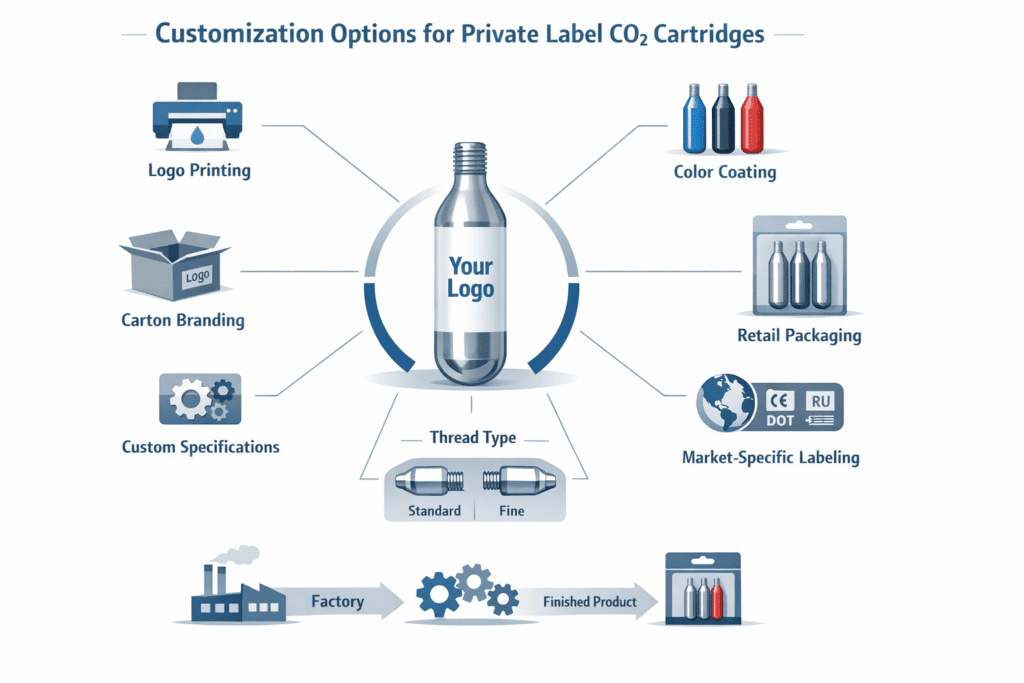
In our daily work, buyers often ask whether we can print their logo on the cartridge body, use their brand colors, or apply a label design that matches their existing product line. This is the most direct way for them to turn a standard product into their own branded item.
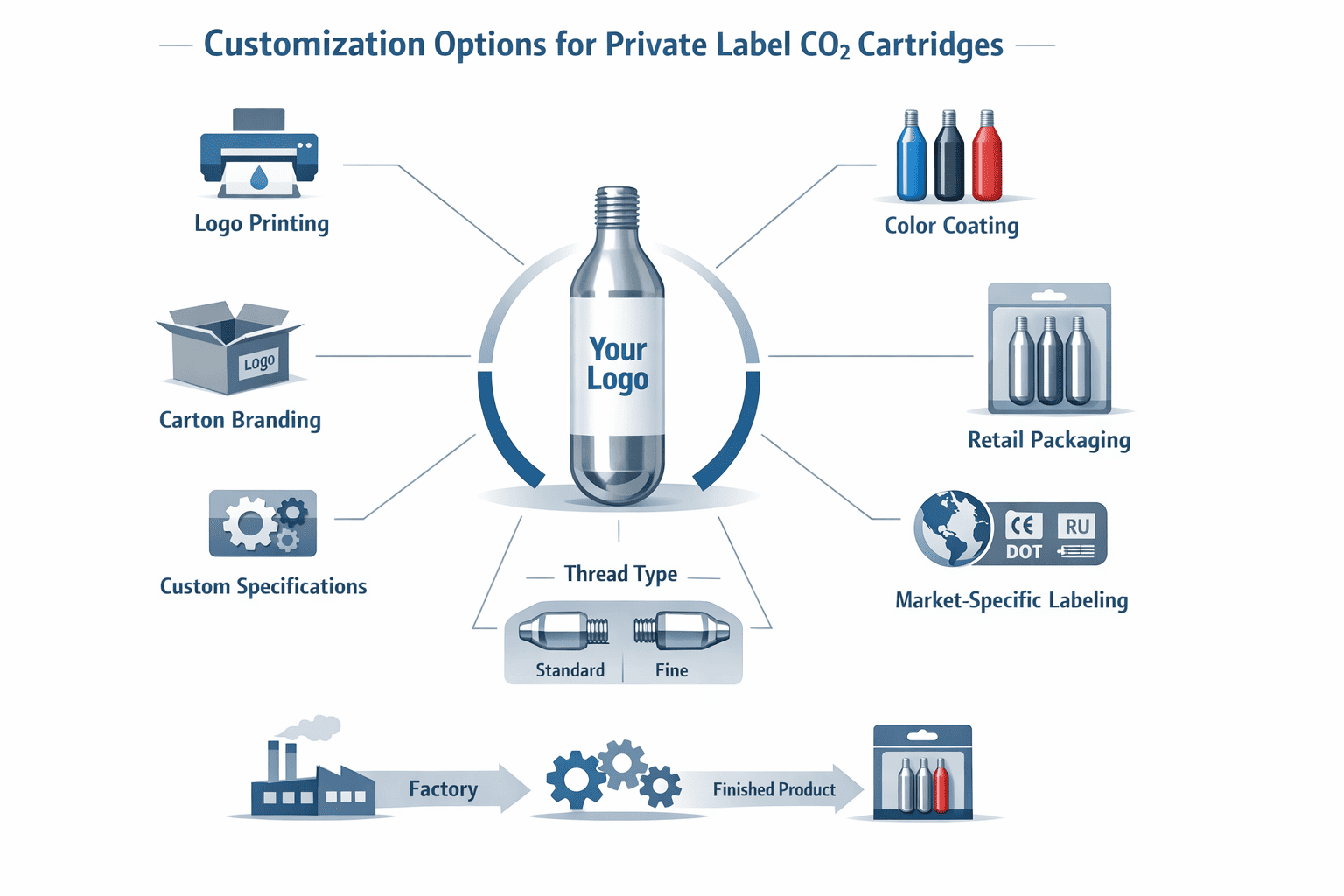
The most common branding requests include:
| Customization type | What buyers usually want |
|---|---|
| Logo printing | Brand name or mark on the cartridge body |
| Color coating | A finish that matches the buyer’s brand style |
| Label design | Product information in the buyer’s visual format |
| Carton branding | Printed outer cartons for wholesale or retail identity |
From my experience, smaller buyers may stop at logo printing, but more serious private label customers usually want the full visual presentation to stay aligned across the cartridge, inner box, and outer carton.
That is one reason branding matters so much in private label business. The product does not only need to work well. It also needs to look like it belongs to the buyer’s brand. The general idea behind this is closely related to how private label products are built around supplier support, branding control, and market differentiation.
Packaging Customization Matters More Than Many Buyers Expect
A lot of first-time buyers focus only on the cartridge itself. Later, they realize that packaging is just as important.
In our factory, packaging discussions often become more detailed once the buyer starts thinking about sales channels. A distributor may want stronger master cartons for easier storage and shipment. A retail brand may want attractive small-box packaging that looks clean on the shelf. A larger importer may need barcodes, SKU labels, or multilingual information for different markets.
Typical packaging customization requests include:
| Packaging option | Why buyers ask for it |
|---|---|
| Retail box design | Supports shelf display and brand image |
| Master carton printing | Helps warehouse handling and product identification |
| Barcode or SKU labels | Supports retail systems and inventory management |
| Multilingual packaging | Fits export markets with different language needs |
| Instruction inserts | Helps explain usage and safety information |
From what I have seen, packaging is often the point where a private label project starts to feel real. It turns a standard industrial product into something that is ready for the buyer’s sales channel.
Buyers Also Expect Custom Specifications
Private label buyers do not always want the exact same standard cartridge.
In some cases, they want a certain cartridge size, thread type, or finish that matches their device or target application. In other cases, they want a product version that better fits local market expectations. This means customization is not only about what the product looks like. It is also about how well it fits the intended use.
Common specification-related requests include:
| Specification request | Why it matters |
|---|---|
| Cartridge size | Must match the intended equipment or application |
| Thread type | Must fit the buyer’s inflator or system |
| Surface finish | Supports both appearance and corrosion control |
| Gas purity requirement | Important for beverage-related products |
| Market-specific labeling | Helps support compliance and local sales needs |
From my side as a manufacturer, this is where customization becomes much more valuable. It helps the buyer create a product line that is not only branded, but also better matched to the market they want to serve.
This also connects directly to the bigger buying logic behind private label sourcing. In our main guide on what private label CO2 cartridge buyers care about beyond unit price, customization is one of the main factors because buyers want suppliers that can support both brand presentation and practical market requirements.
Buyers Expect Customization Without Losing Consistency
This is one point that serious buyers care about very much: customization should not make quality unstable.
In our factory, experienced buyers often ask two questions together. First, can you customize the product for us? Second, can you keep that customized version stable across every batch?
That is a very reasonable concern. A private label product only works when the appearance, dimensions, and packaging stay consistent from one shipment to the next. If the logo position changes, the color tone varies, or the carton printing quality drops, the buyer’s brand image suffers.
Here is how buyers usually think about this:
| Buyer concern | What they really want |
|---|---|
| Can you customize this product? | Can you make it fit my brand? |
| Can you repeat it exactly? | Can my next order look the same? |
| Can you scale it? | Can customization stay stable as volume grows? |
From my experience, strong private label cooperation depends on both flexibility and control. Buyers do not want a supplier that can only say yes once. They want a supplier that can deliver the same customized solution again and again.
Serious Buyers Often Think Beyond the First Order
The most professional private label buyers are usually not thinking about one shipment only.
At the beginning, they may ask for simple custom printing or custom packaging. But what they are really testing is whether the supplier can support their growth later. They may start with one SKU, then expand into multiple sizes, new packaging formats, or different applications as their sales develop.
In our work, I often notice that this is the point where buyers begin to evaluate the supplier more carefully. They want to know whether customization is just a one-time service or part of a longer partnership.
The questions behind that concern often include:
- Can you keep the same branding standard across repeat orders?
- Can you support new packaging formats later?
- Can you manage multiple SKUs if our business grows?
- Can you keep quality stable while customization becomes more complex?
From my point of view, this is what separates a basic supplier from a real private label manufacturing partner.
Conclusion
Private label buyers usually expect much more than a logo on the cartridge. From my experience, they want a combination of branding, packaging, specification control, and repeatable production support that helps them build a real product line for their market. In practice, the best customization is not only attractive. It is consistent, scalable, and reliable over time.