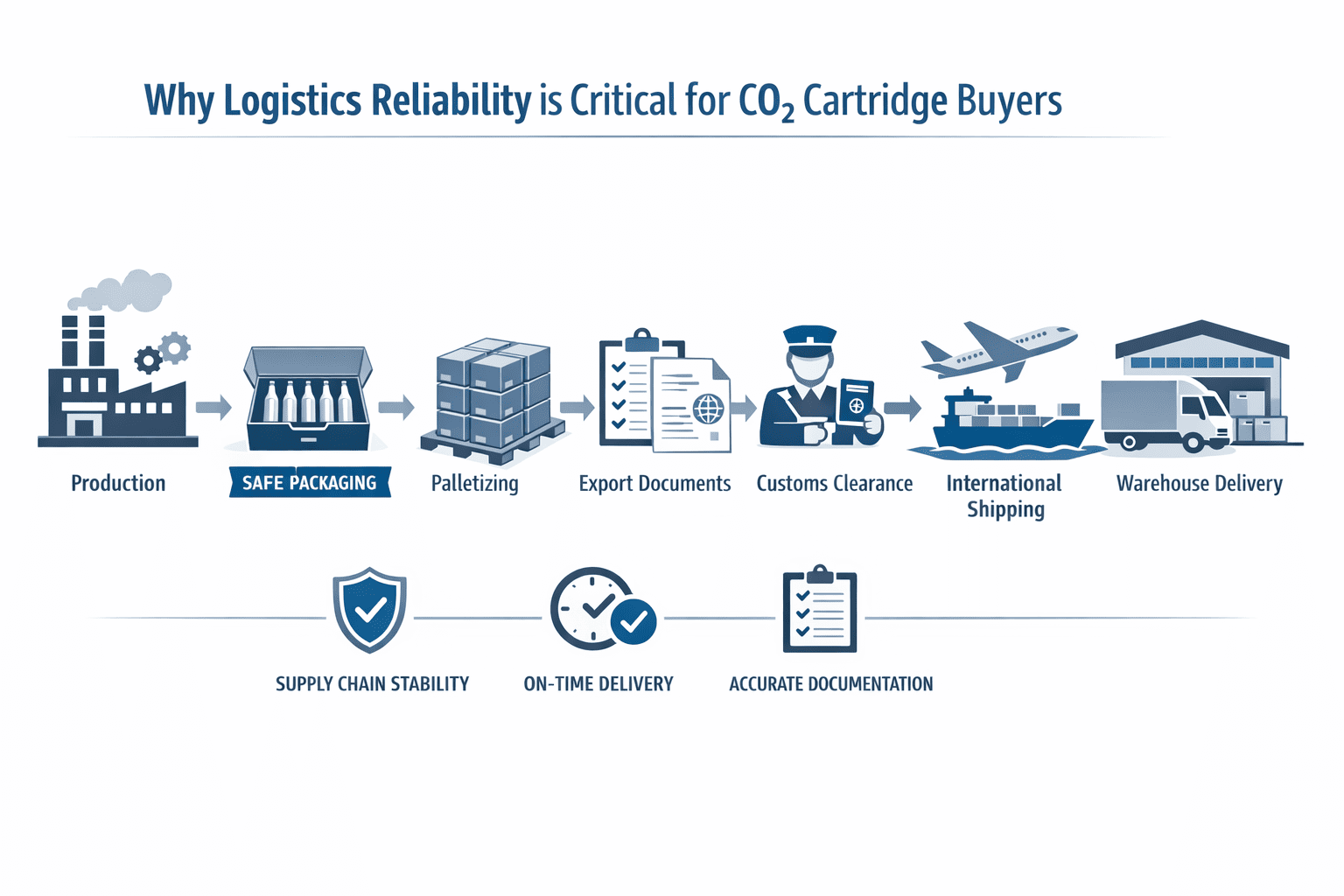
Logistics reliability is critical for CO2 cartridge buyers because delayed, damaged, or non-compliant shipments can interrupt supply, increase costs, and damage customer trust. From my experience as a manufacturer, buyers do not only need a good product. They also need confidence that the goods can move safely, legally, and on schedule from the factory to their warehouse.
Supply Chain Priorities
- Buyers need shipments to arrive on time and in stable condition.
- Export documentation matters because CO2 cartridges are pressurized products.
- Poor logistics can create customs delays, stock shortages, and extra costs.
- Reliable shipping helps distributors protect customer relationships.
- Serious buyers prefer suppliers that understand export compliance and repeat delivery.
Introduction
When buyers compare suppliers, many first look at price and product quality. Later, they realize that logistics reliability can be just as important.
In our factory, I have seen this happen many times. A buyer may be satisfied with the cartridge itself, but if the shipment is delayed, the paperwork is incomplete, or the packaging is not suitable for transport, the whole order becomes a problem. For distributors and private label brands, the issue is not only whether the product is made correctly. It is also whether it can arrive correctly.
This is especially important in the CO2 cartridge business. These are pressurized products. They require proper handling, proper labeling, and consistent export preparation. If one part of the logistics process is weak, the buyer may face customs issues, warehouse shortages, or unhappy customers downstream.
That is why experienced buyers usually treat logistics reliability as a core part of supplier evaluation, not as an afterthought.
Delivery Stability Protects the Buyer’s Business
For many B2B buyers, logistics reliability starts with one simple question: can this supplier deliver on time?
From my experience, this is one of the biggest concerns for distributors and wholesalers. Their own customers are waiting for stock. Retail programs, seasonal promotions, and repeat orders all depend on stable delivery. If the goods arrive late, the buyer may miss sales opportunities or disappoint key accounts.
This is why delivery reliability matters far beyond shipping itself.
| Logistics issue | Business impact |
|---|---|
| Late shipment | Missed sales windows and stock shortages |
| Partial delivery | Incomplete customer fulfillment |
| Unstable transit planning | Difficult inventory forecasting |
| Damaged cargo | Product replacement and customer complaints |
In real business, a late shipment can quickly become a sales problem. Buyers do not only lose time. They may also lose trust from dealers, retailers, or brand partners who expect steady supply.
Export Readiness Matters More Than Many Buyers Expect
A supplier may produce a good cartridge, but that alone is not enough.
In our daily export work, one thing is very clear: buyers want suppliers that understand how to prepare goods properly for international shipment. CO2 cartridges are not ordinary metal parts. They are pressurized products, so documentation, labeling, and packaging must all be handled with care.
This is where many hidden risks appear. A shipment can be delayed not because the product is bad, but because the export file is incomplete or the logistics preparation is weak.
Typical areas buyers care about include:
| Export factor | Why buyers care |
|---|---|
| Shipping documents | Needed for customs and carrier review |
| Labeling accuracy | Helps avoid clearance problems |
| Packaging suitability | Protects goods in transit |
| Batch traceability | Supports importer and compliance records |
From my point of view, export readiness is one of the clearest signs of whether a supplier is really prepared for long-term B2B business. Buyers feel much safer when the factory can explain the logistics process clearly and provide the needed documents in an organized way.
Safe Transport Is Part of Product Reliability
Many buyers think about quality only in terms of manufacturing. But in practice, transport is also part of product reliability.
In our factory, we understand that even a well-made cartridge can become a problem if it is packed poorly or handled without enough control. Buyers do not only want a cartridge that leaves the production line in good condition. They want a cartridge that reaches their warehouse in good condition too.
That means logistics reliability includes:
- proper palletizing
- protective packaging
- clear carton marking
- shipment planning that reduces transit risk
This matters because transport damage creates the same result as production defects: complaints, replacements, and wasted cost.
That is also why logistics connects directly to the larger supplier evaluation logic. In our main guide on what private label CO2 cartridge buyers care about beyond unit price, logistics reliability is one of the main factors because buyers need both product quality and dependable delivery to build a stable business.
Customs Delays Can Be More Expensive Than Buyers Expect
In my experience, many new buyers first focus on product price, then later discover how expensive logistics problems can become.
A customs delay does not always look dramatic at the beginning. Sometimes it is only a few extra days. But for a distributor with committed orders, that delay can create a chain reaction. Inventory runs low. Customers start asking questions. The buyer’s team spends time chasing paperwork or rechecking shipment status. In some cases, the buyer must even arrange alternative stock at a higher cost.
This is why serious buyers care about the supplier’s logistics experience.
| Delay source | Possible result |
|---|---|
| Incomplete documentation | Customs hold or extra review |
| Incorrect labeling | Clearance delays or relabeling |
| Weak packaging preparation | Cargo damage or rejection |
| Poor shipment coordination | Missed delivery windows |
From what I have seen, logistics problems are often more painful than buyers expect because they do not stay in one part of the business. They quickly affect inventory, customer communication, and future order planning.
Buyers Want Predictability, Not Just Shipment Movement
Good logistics is not only about sending goods out. It is about making the shipping process predictable.
In our work with B2B buyers, I have found that predictability is often what gives them the most confidence. They want to know when the goods will be ready, when they will leave, what documents will be provided, and how the shipment is being handled. This helps them plan warehouse space, inventory, and downstream sales.
From the buyer’s side, predictable logistics usually means:
| Buyer expectation | Why it matters |
|---|---|
| Clear lead time | Helps plan stock and reorders |
| Organized shipment updates | Reduces uncertainty |
| Consistent export documents | Supports repeat importing |
| Stable logistics process | Builds trust over time |
That is why many experienced buyers prefer a supplier that ships reliably every time over a supplier that sometimes ships fast and sometimes creates problems. In B2B trade, consistency often matters more than occasional speed.
Strong Logistics Support Helps Buyers Scale
The most serious buyers are usually not thinking about one order only. They are thinking about whether the supplier can support repeat business and larger volume later.
In our factory, I often see that distributors and private label brands become more focused on logistics as their order size grows. At the beginning, they may only ask when the goods can ship. Later, they start asking whether the supplier can handle larger pallet volumes, repeated export schedules, and stable documentation across many orders.
This is a good sign. It means the buyer is thinking long term.
Reliable logistics helps buyers scale because it reduces uncertainty. It allows them to commit to customers more confidently, plan inventory more accurately, and expand without constantly worrying about shipment problems. In that sense, logistics reliability is not only an operational issue. It is part of growth support.
A useful way to understand this is through the broader idea of supply chain management, where procurement, transportation, inventory, and delivery all affect business stability together. In the CO2 cartridge trade, that connection becomes very clear.
Conclusion
Logistics reliability is critical for CO2 cartridge buyers because a good product alone is not enough. From my experience, buyers need shipments that are timely, compliant, well packed, and predictable. When logistics is stable, buyers can protect inventory, serve customers better, and build stronger long-term partnerships.