Buyers evaluate manufacturing capacity by looking at whether a factory can deliver stable output, consistent quality, reasonable lead times, and repeatable supply across different order volumes. From my experience, serious CO2 cartridge buyers do not only ask how many pieces a factory can make per day. They want to know whether that capacity is real, stable, and supported by a controlled production system.
Capacity Evaluation Points
- Buyers want to know whether capacity is stable, not just whether it looks large on paper.
- Production lines, equipment, labor, and process control all affect real output.
- Lead time consistency is often more important than a big capacity claim.
- A factory must support both volume and quality at the same time.
- Serious buyers usually check whether capacity can grow with their business.
Introduction
When buyers ask about manufacturing capacity, they are usually thinking about risk.
In our factory, this question often comes up after the first discussion about product specifications and price. At that stage, buyers already understand what they want to buy. The next thing they want to know is whether we can support their business over time.
This is especially important in the CO2 cartridge business. Some buyers place regular wholesale orders. Some are building their own private label brand. Some are planning seasonal sales and cannot afford delays during peak demand. In all these cases, manufacturing capacity becomes a practical issue, not just a factory introduction point.
A buyer may accept a slightly higher price from a factory with stable output. But most buyers do not want to risk working with a supplier that promises high volume and then struggles with delivery, quality, or repeated replenishment.
Buyers Usually Start with Production Line Capacity
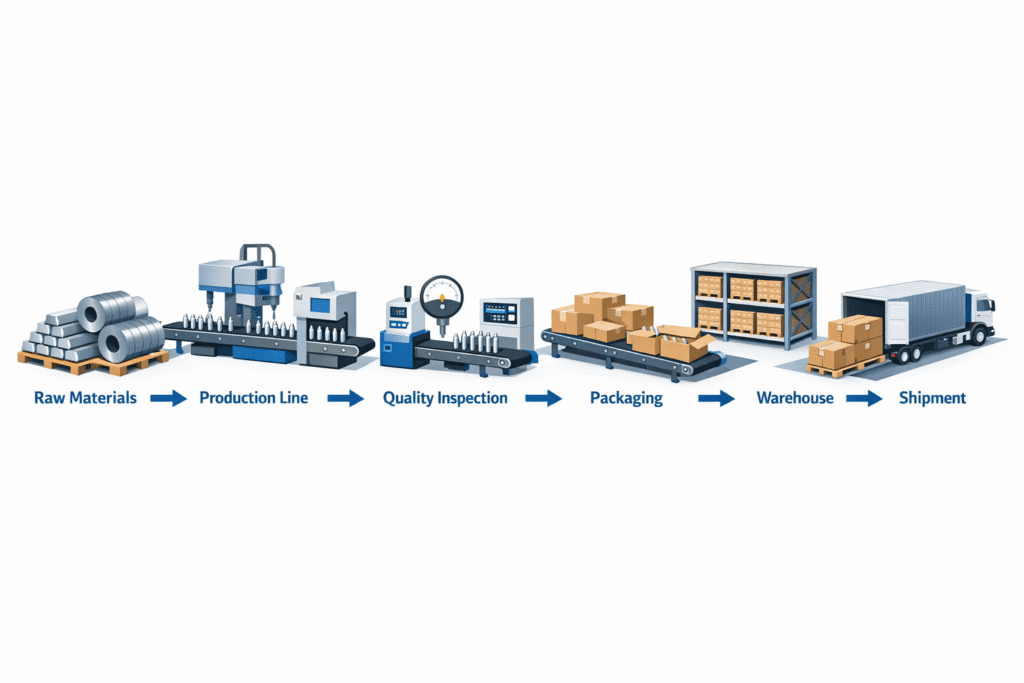
In my experience, the first thing buyers want to understand is the basic production structure.
They often ask how many production lines a factory has, how many shifts it runs, and whether the factory focuses on one type of cartridge or multiple specifications. These questions are simple, but they tell the buyer a lot.
A factory with several production lines usually gives buyers more confidence because it suggests stronger output and better flexibility. At the same time, experienced buyers know that the number of lines alone does not tell the whole story. A factory may have multiple lines, but if the equipment is outdated or the workflow is weak, real production may still be unstable.
Here are some of the things buyers usually look at first:
| Capacity factor | What buyers want to understand |
|---|---|
| Number of production lines | Whether the factory can support larger or repeated orders |
| Type of equipment | Whether production is modern and efficient |
| Shift arrangement | Whether output can be increased when needed |
| Product range | Whether the factory can handle different cartridge sizes |
From my side, I have found that buyers feel more comfortable when capacity is explained clearly and simply. Big claims do not help much unless they are supported by a real production structure.
Real Capacity Means More Than Daily Output
Some factories like to talk only about how many pieces they can produce in one day. Buyers do ask about this, but serious buyers usually go deeper.
From what I have seen, professional importers and brand owners care more about whether the factory can maintain output over time. They do not only want a peak number. They want to know what the factory can do consistently across normal production weeks and busy seasons.
This is where real capacity becomes different from claimed capacity.
| Claimed capacity question | Real capacity question |
|---|---|
| How many pieces can you make in one day? | How many pieces can you deliver consistently each month? |
| Can you handle a large order? | Can you handle repeat orders without delays? |
| Do you have enough machines? | Do you have enough control to keep quality stable at higher volume? |
In our work, I have noticed that experienced buyers care a lot about this difference. They know that some suppliers look strong during quotation, but become weak when order volume increases. That is why real capacity must always be linked with quality control and delivery performance.
Buyers Check Lead Time as a Sign of Capacity
Lead time is one of the clearest ways buyers evaluate manufacturing capacity.
A factory may say it has strong capacity, but if lead times keep changing or shipments are delayed, buyers quickly lose confidence. In real business, stable lead time often matters more than a very aggressive capacity promise.
When buyers review capacity, they usually think about questions like these:
- Can this factory deliver on schedule?
- Can it keep the same lead time for repeat orders?
- Can it support my peak season without affecting quality?
- Can it respond if my demand grows faster than expected?
From my experience, buyers who already work with distributors or retailers are especially sensitive to lead time stability. Their own customers are waiting for stock, so they need a supplier that can plan production in a disciplined way.
That is also why manufacturing capacity connects directly to the broader supplier evaluation process. In our main guide on what private label CO2 cartridge buyers care about beyond unit price, production capacity is one of the core factors because it affects delivery reliability, reorder confidence, and long-term partnership value.
Buyers Want to Know Whether Quality Holds at Higher Volume
This point is very important. Good buyers do not separate capacity from quality.
In our factory, we know that output only has value if the quality stays stable. A factory that produces more pieces but creates more leaks, thread problems, or batch variation is not giving the buyer real capacity. It is only creating a bigger risk.
So when buyers evaluate manufacturing capacity, they are often indirectly evaluating process control as well. They want to know whether the factory can increase production without losing consistency.
Typical questions behind this concern include:
| Buyer concern | What it really means |
|---|---|
| Can you handle larger orders? | Can you keep quality stable at larger volume? |
| Can you shorten lead time? | Can you do it without rushing and causing defects? |
| Can you support long-term growth? | Can your system stay reliable as order volume increases? |
This is one reason why many buyers care about factory systems and management standards. A structured quality management approach, such as the framework described in ISO 9001 quality management principles, gives buyers more confidence that higher output is supported by repeatable control, not just speed.
Buyers Also Look at Raw Material and Supply Stability
Manufacturing capacity is not only about what happens inside the workshop. Buyers also think about whether the factory can secure raw materials and key components.
If a supplier depends on unstable raw material sourcing, production capacity becomes fragile. The factory may have machines and workers ready, but still fail to deliver because materials arrive late or inconsistently.
From my experience, this part becomes more important when buyers are planning long-term cooperation. They want to know whether the factory has a stable supply chain behind the production line.
Here are some common signals buyers look for:
| Supply factor | Why buyers care |
|---|---|
| Stable raw material sourcing | Reduces production interruptions |
| Long-term supplier relationships | Supports better planning |
| Material specification control | Helps keep product consistency stable |
| Backup production planning | Reduces risk during demand spikes |
In practice, buyers do not always ask every question directly. But they usually notice very quickly whether a factory understands supply stability as part of capacity.
Buyers Prefer Capacity That Can Grow with Them
The best buyers are usually not thinking about one order only. They are thinking about what happens after the first successful shipment.
If their market grows, they want to know whether the factory can grow with them. That is why buyers often evaluate capacity not only for current demand, but also for future demand.
In our factory, I have seen that private label buyers and larger distributors care a lot about this point. They do not want to change suppliers once their sales increase. They prefer to start with a factory that can support them from smaller trial orders to larger repeat business.
This makes capacity a long-term trust issue. Buyers want a supplier that can support today’s order without becoming tomorrow’s bottleneck.
Conclusion
Buyers evaluate manufacturing capacity by looking far beyond a simple output number. From my experience, they want to see stable production lines, reliable lead times, quality consistency at higher volume, secure raw material supply, and enough room to support future growth. In real B2B sourcing, good manufacturing capacity is not just about making more. It is about delivering steadily, predictably, and with the same quality every time.