
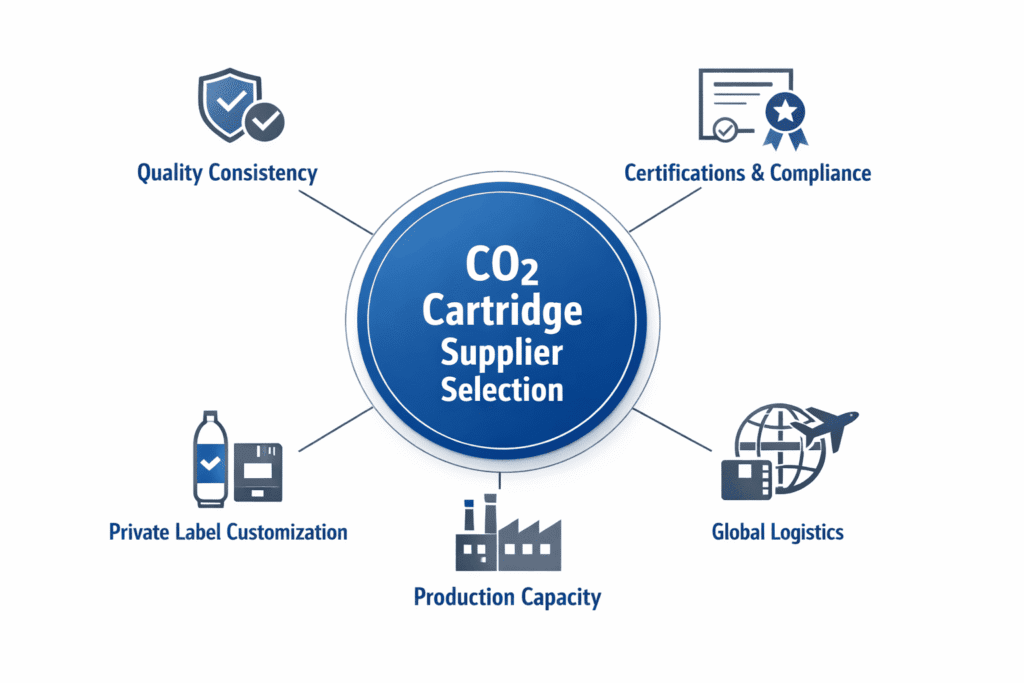
Private label CO2 cartridge buyers usually care about five critical factors beyond unit price: product quality consistency, regulatory certifications, manufacturing capacity, private label customization, and reliable international logistics. For distributors and brand owners, these factors directly affect product safety, supply stability, and long-term brand reputation.
Buyer Checklist
- Quality consistency prevents leaks, device failures, and costly recalls.
- Certifications ensure legal import and regulatory compliance.
- Production capacity guarantees stable supply for distributors.
- Private label customization supports brand positioning.
- Reliable logistics ensures safe global transportation of pressurized cartridges.
Introduction
Many buyers begin sourcing CO2 cartridges by comparing prices from multiple suppliers.
However, focusing only on the lowest price can create bigger risks later. Cheap cartridges may fail pressure tests, lack proper certifications, or cause supply interruptions. For distributors and private label brands, these issues can damage customer trust and increase operational costs.
Experienced buyers understand this reality. Instead of selecting suppliers purely based on price, they evaluate deeper factors that determine whether a manufacturer can support their business long term.
Below are the five factors that professional buyers usually prioritize when choosing a private label CO2 cartridge supplier.
Quality Consistency Summary
Consistent product quality is usually the first factor professional buyers evaluate when selecting a CO2 cartridge supplier.
👉 Why does quality consistency matter more than price?
Key Quality Indicators Buyers Check
| Quality Factor | Why It Matters |
|---|---|
| Gas purity | Ensures safe use in beverage or equipment applications |
| Cylinder wall thickness | Determines pressure resistance and safety |
| Thread accuracy | Ensures compatibility with inflators and devices |
| Leak detection | Prevents failures during storage or transport |
Reliable manufacturers follow strict production processes including steel pipe cutting, cylinder forming, welding, polishing, leak testing, and internal cleaning. These steps ensure each cartridge performs consistently across large production batches.
Certification and Compliance Summary
Certifications determine whether CO2 cartridges can legally enter international markets.
👉 Which certifications do CO2 cartridge buyers usually require?
Common Certifications for CO2 Cartridges
| Certification | Purpose |
|---|---|
| ISO quality system | Confirms standardized manufacturing processes |
| CE / transport compliance | Required in many European markets |
| Food-grade certification | Necessary for beverage applications |
| MSDS documentation | Required for shipping pressurized gas |
Because CO2 cartridges are pressurized containers, they must comply with safety standards used for gas cylinders. Organizations such as the International Organization for Standardization (ISO) define global technical standards for manufacturing and testing pressure vessels.
Production Capacity Summary
Production capacity determines whether a manufacturer can support long-term distribution.
👉 How do buyers evaluate manufacturing capacity?
Capacity Indicators Buyers Consider
| Production Factor | Buyer Concern |
|---|---|
| Number of production lines | Determines maximum production output |
| Lead time stability | Helps distributors plan inventory |
| Raw material supply | Prevents manufacturing interruptions |
| Automation level | Improves consistency and efficiency |
Large distributors often require stable supply across tens or hundreds of thousands of cartridges annually. Manufacturers with strong production infrastructure are therefore more attractive partners.
Private Label Customization Summary
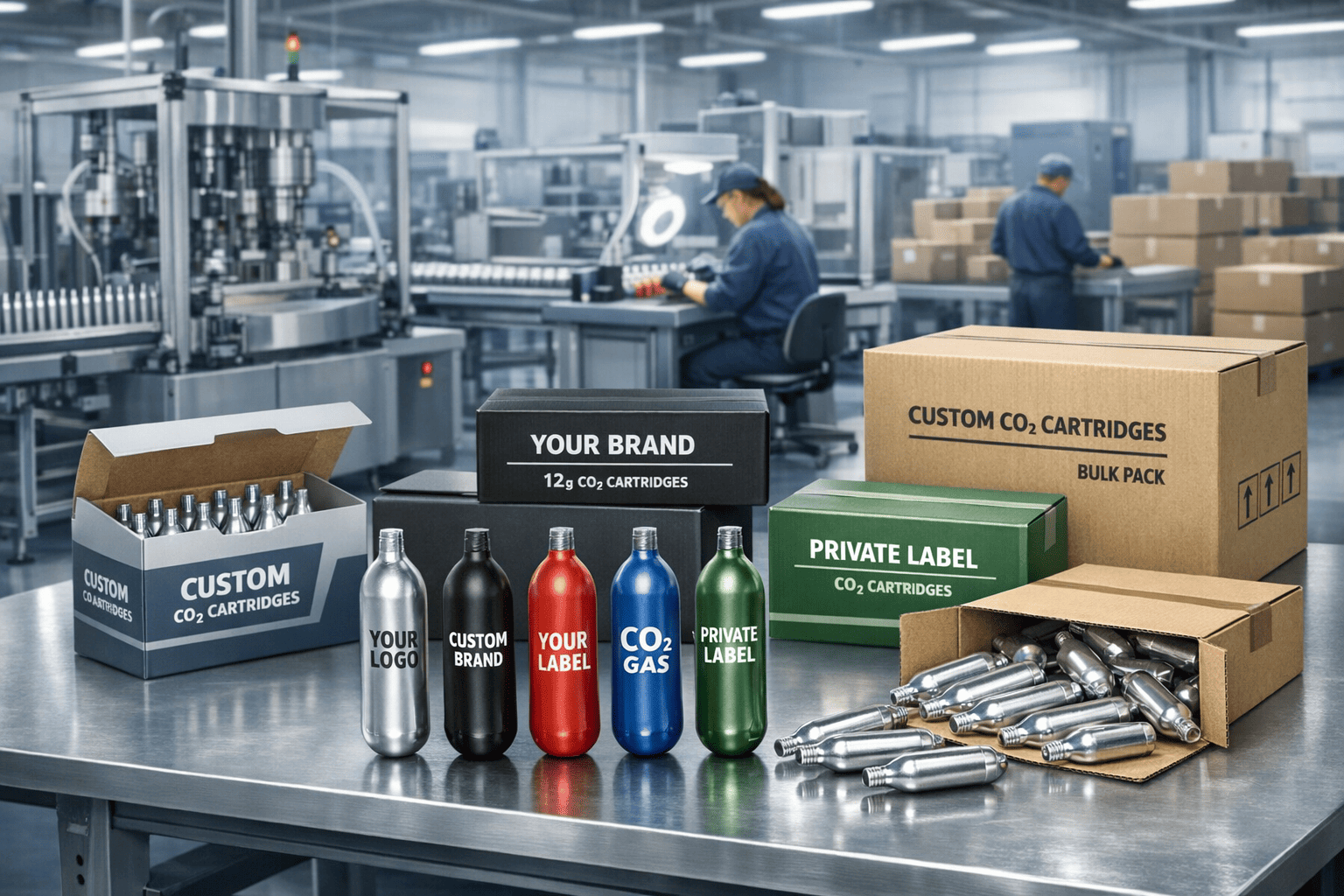
Customization is essential for brands that sell CO2 cartridges under their own label.
👉 What customization options do private label buyers expect?
Common Private Label Options
| Customization Type | Benefit |
|---|---|
| Logo printing on cylinders | Strengthens brand recognition |
| Cylinder color coating | Differentiates product lines |
| Retail packaging design | Supports distributor marketing |
| Custom specifications | Ensures compatibility with devices |
Many companies entering the CO2 cartridge market also need guidance on how to source products internationally. For example, buyers importing from Asia often review guides on how to import CO2 cartridges from China before selecting a supplier:
Logistics and Shipping Reliability Summary
Shipping pressurized cartridges internationally requires specialized logistics knowledge.
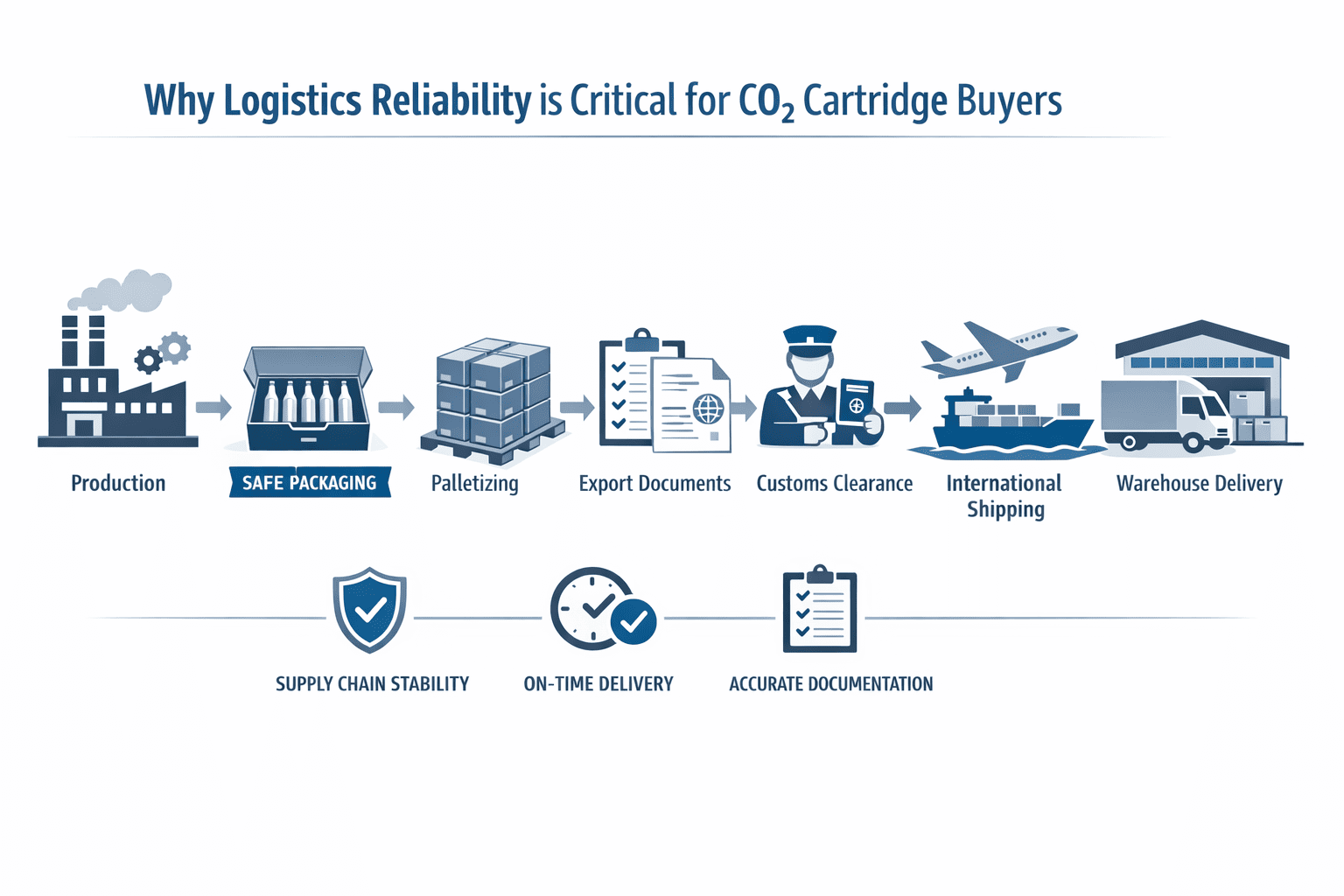
👉 Why is logistics reliability critical for CO2 cartridge buyers?
Logistics Factors Buyers Evaluate
| Logistics Factor | Importance |
|---|---|
| Dangerous goods handling | Required for pressurized gas transport |
| Export documentation | Prevents customs clearance issues |
| Protective packaging | Prevents damage during shipping |
| Delivery stability | Ensures distributors maintain inventory |
CO2 cartridges are typically transported under regulations for compressed gases. Experienced exporters understand labeling requirements, packaging rules, and documentation needed to ship these products safely across international markets.
Conclusion
Private label CO2 cartridge buyers rarely choose suppliers based on price alone. Quality consistency, regulatory compliance, production capacity, customization capability, and reliable logistics are the real factors that determine long-term partnerships. Selecting the right manufacturer helps protect both product safety and supply stability.

One Response